18th Century Chinese Tapestry
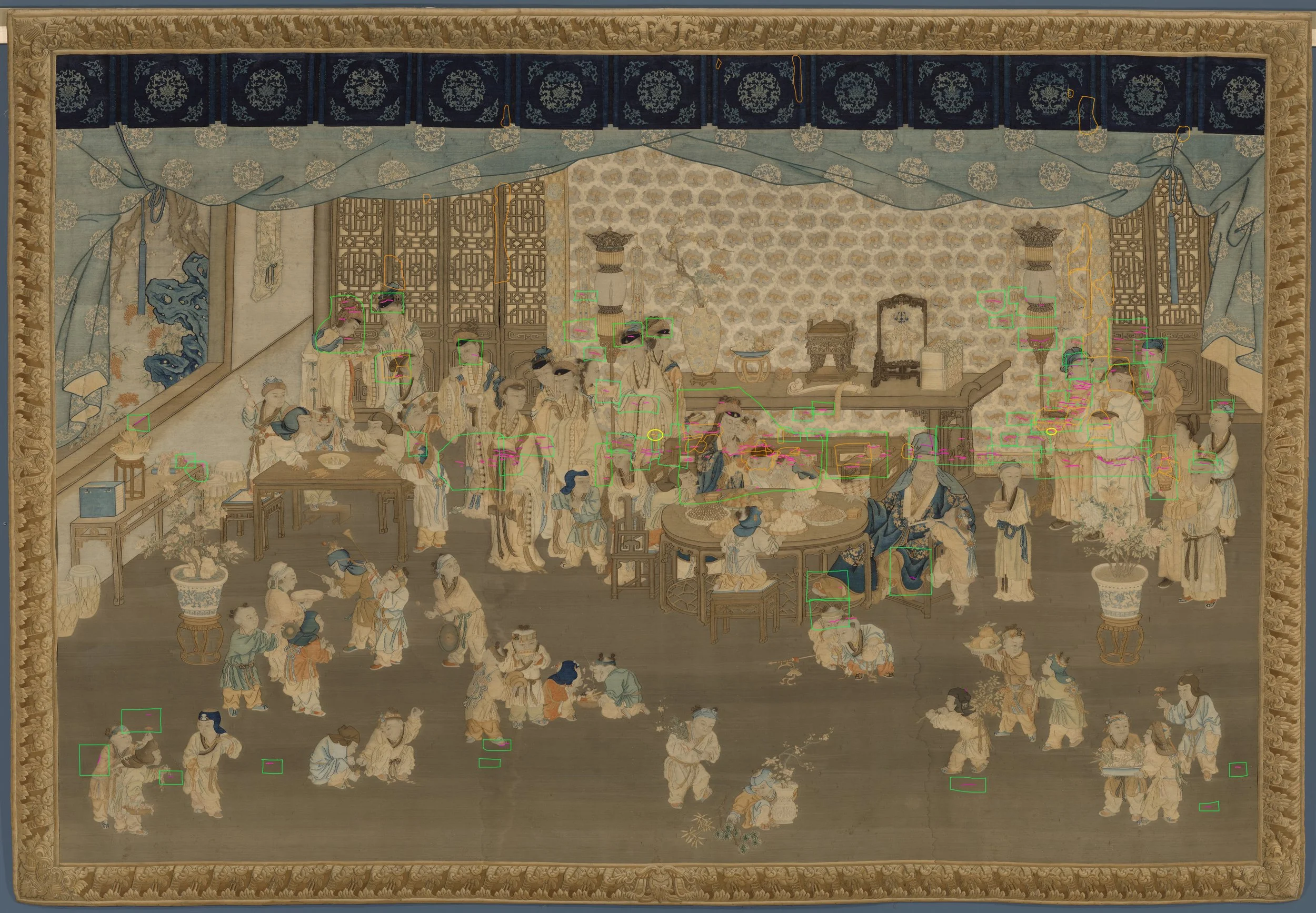
Family Gathering on New Year’s Morning, Chinese, late 1740s, 257.8 x 377.8 cm, Cleveland Museum of Art, 1942.825
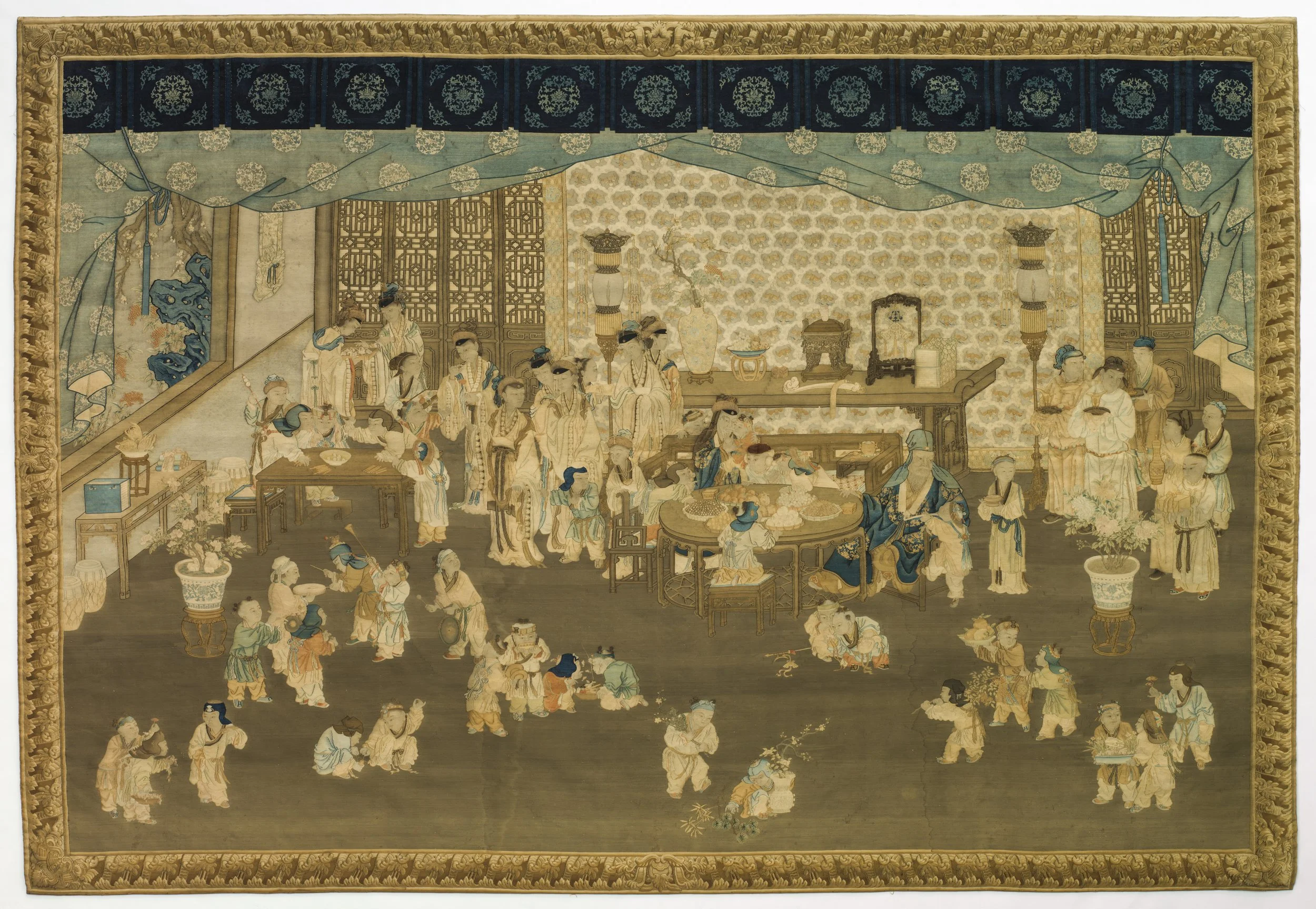
Before Treatment, Overall Front, 2014. Photo Courtesy of Cleveland Museum of Art.
This extremely special tapestry is one of three known to have been produced in China in the late 1740s. One is in China, one is missing, and the other is in the collection of the Cleveland Museum of Art. This piece is slated to be in an upcoming exhibition China’s Southern Paradise: Treasures from the Lower Yangzi Delta. Although the tapestry was woven in China, it is in the French style and incorporates a variety of textile techniques including applied color and embroidery.
Unfortunately, the nature of the tapestry is also causing some condition issues. Instead of having the traditional wool warps in the horizontal direction, this tapestry has raw silk warps in the vertical direction. Because of this, the warps have been under tension and are starting to break causing instability throughout the tapestry. Sewing through the tapestry is nearly impossible, not only would it cause more damage to the silk warps and weft, but the dense nature of the weave also makes it very difficult.
So the team at St. John the Divine decided on an adhesive treatment, a technique rarely used on tapestries.
This treatment is currently in process and thus a post-treatment report is upcoming.
Pre-Treatment Mapping
To make sense of this very complex piece Cleveland summer intern Kat McFarlin and FIT intern Ayako Tanihata created this in-depth map. The map breaks the tapestry up into sections and highlights breaks, stains, embroidery, and the complex system of patches from previous repairs on the back (not shown on the right).
As you can see from their fabulous work, the majority of the breaks are throughout the figural group in the center of the tapestry as well as a concerning cluster of breaks along the bottom third of the tapestry in the vast brown wool floor.
Many of these breaks are exacerbated by previous darning repairs and patches that are starting to break the tapestry around them.
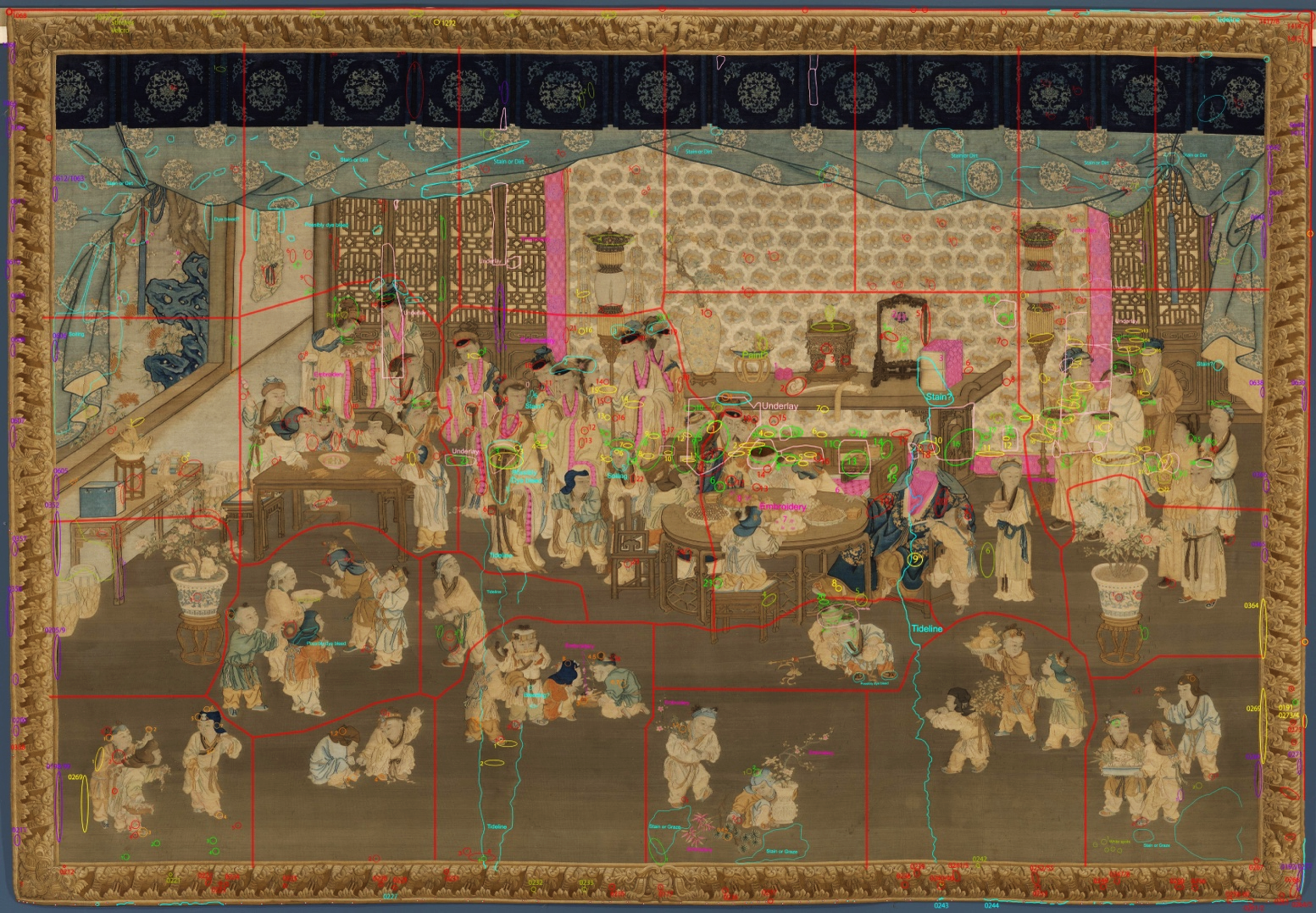
Pre-treatment Condition map by Kat McFarlin and Ayako Tanihata
A Sticky Situation
Adhesives are not normally used on tapestries because of the thickness and dimensionality of the object. However, this is not a usual treatment. A comprehensive report was compiled of textile adhesive literature and the comprehensive testing of Lascaux 360 and 498 with various substrates.
Download the report HERE. Note- this is a HUGE file.
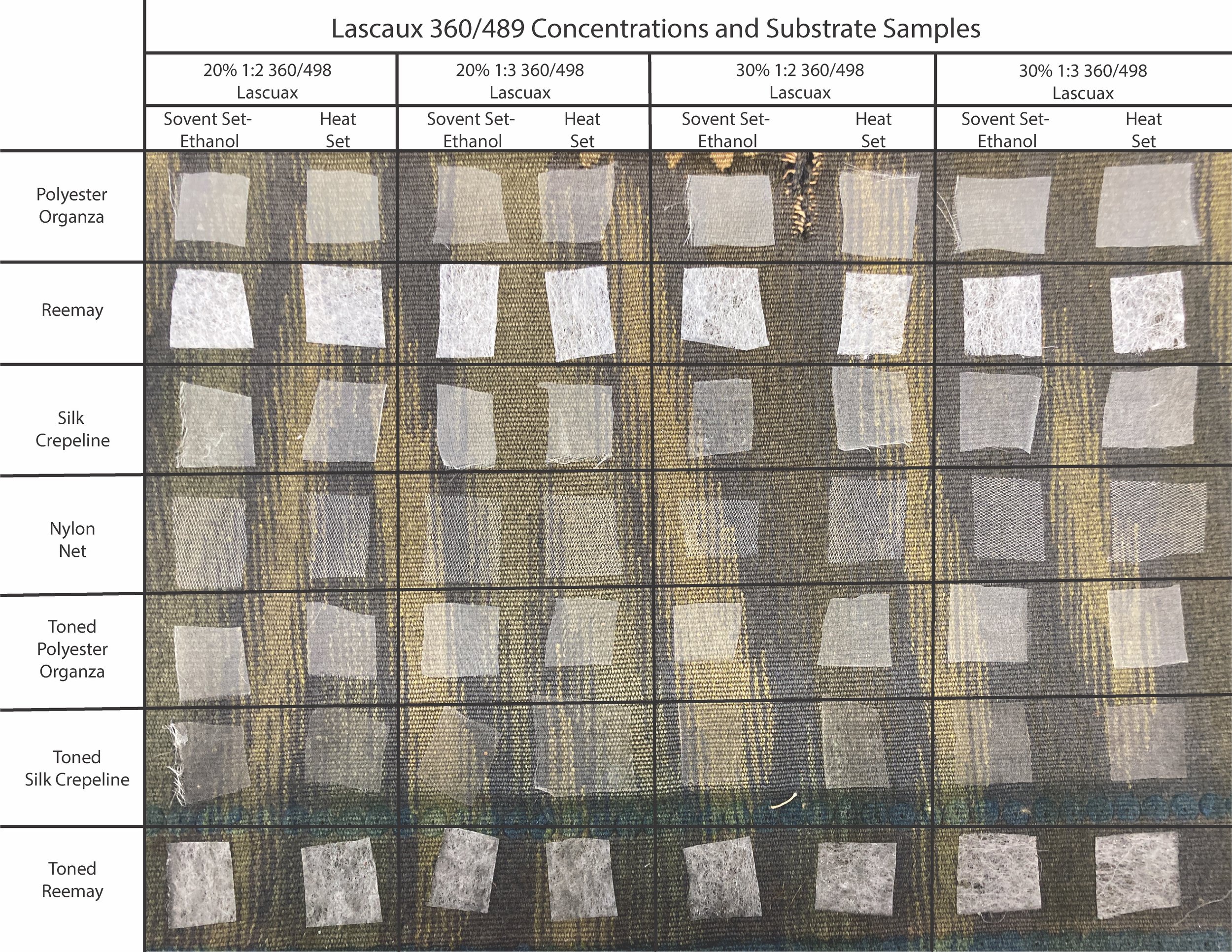
TL;DR- None of the Lascaux mixtures had enough hold. The nylon net applied with heat was the best but there were concerns with the shininess and exposed unadhered adhesive.
Right- Diagram of Lascaux Concentrations and Substrate Samples on test tapestry sample.
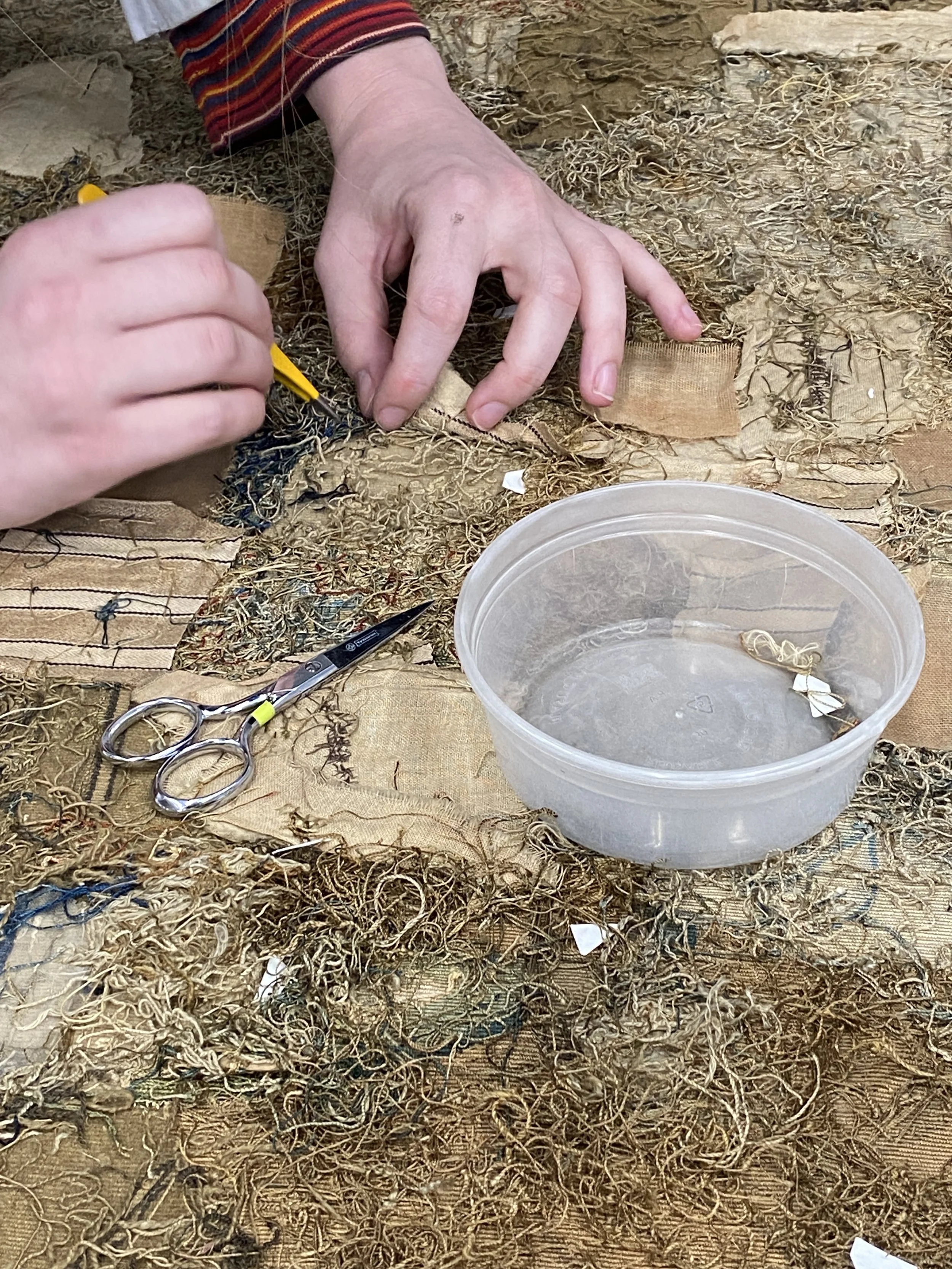
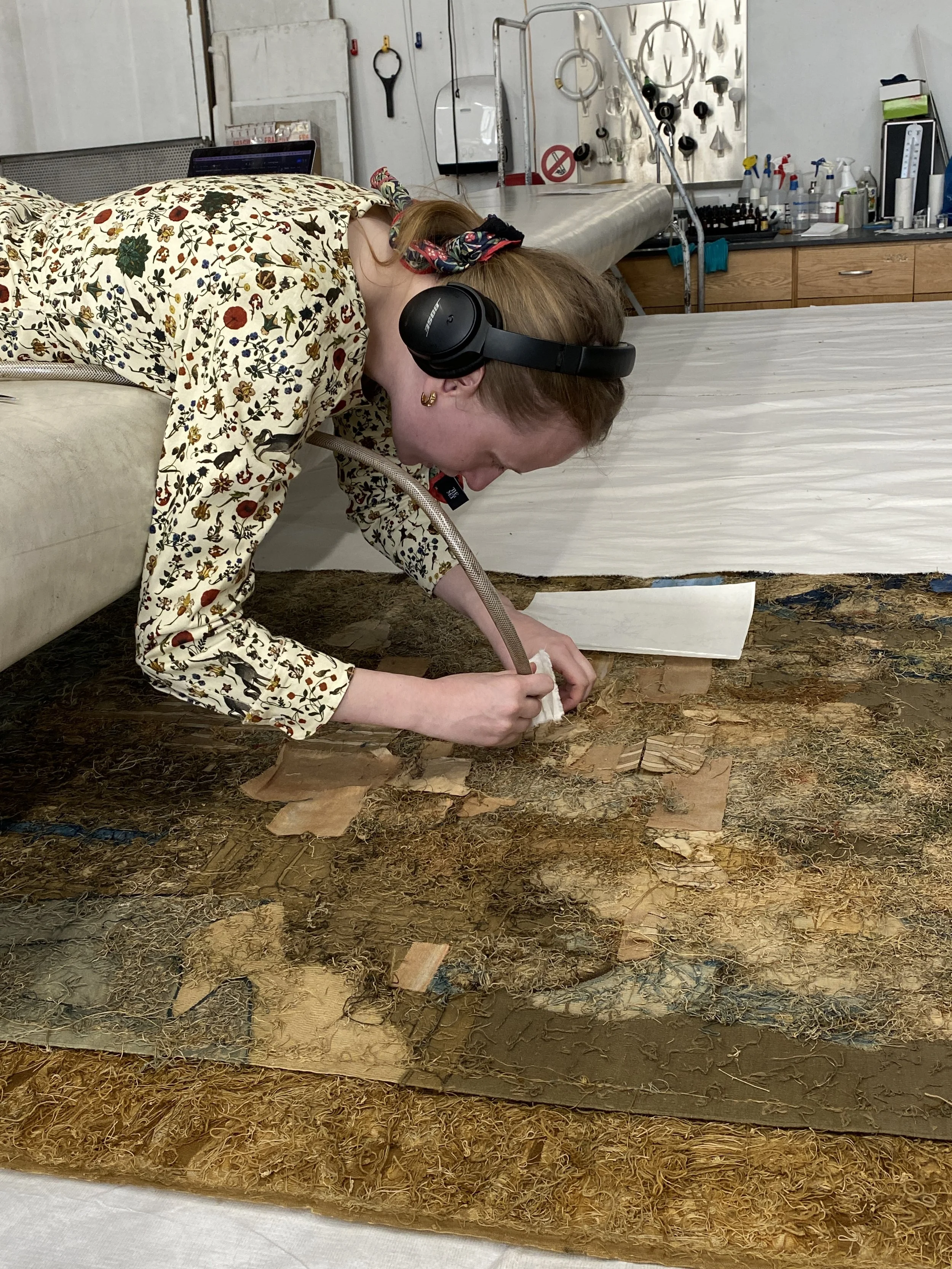
Margaret O’Neil prepping the break area for an adhesive patch. Photo Credit: Margaret O’Neil
BEVA Film to the Rescue
After extensive testing with Lascaux and consultations with many different conservators, the team decided on using BEVA 371 film with a toned soft cotton buckram backing applied low-heat Teflon spatula.
To learn more about this method download the report HERE.
The BEVA 371 film gave a good hold with a flexible thin film. The patch can be pulled up with some force but does not come off on its own. The cotton backing was used to mitigate dust build-up over time and to further protect the breaks.
The patches were put on the back of the tapestry. As much of the old patches were removed to gain access to the breaks. If the patches could not be removed, BEVA film was slipped under the breaks from the front of the tapestry.
Old stitches were also cut if they were not too darned on the surface. This allowed for better access to the break edges as many of these stitches bound the many loose ends to the tapestry.
A New Diagram
The new diagram shows the current breaks that have been repaired and the new map of patches underneath. Download the full-sized diagram HERE.
Detail of new diagram. Diagram by Margaret O’Neil